Outsourced IT vs In-House IT: Which Is Better For Your Growing Business?
- Jonathan Sansone
- Jan 3
- 7 min read
Choosing between outsourced IT and hiring an in-house IT team can feel overwhelming, especially when your business is growing and technology decisions feel more critical than ever. You're not alone if you're wondering whether you should bring IT expertise in-house or partner with a managed IT services provider. This decision impacts everything from your budget to your daily operations, and there's no one-size-fits-all answer.
The good news? Once you understand the real costs, benefits, and trade-offs of each approach, the right choice for your Hampton Roads business becomes much clearer. Let's break down what you need to know to make this decision with confidence.
The Real Costs of Each Approach
When most business owners think about IT costs, they focus on the obvious expenses. But the true cost comparison goes much deeper than monthly fees versus employee salaries.
In-House IT Costs
Hiring an internal IT person in the Virginia Beach area typically means paying $55,000 to $85,000 annually, plus benefits, which can add another 20-30% to that salary. But that's just the beginning. You'll also need to budget for:
Training and certifications to keep skills current
Software licenses and tools for monitoring and management
Hardware for testing and repairs
Time off coverage when your IT person is sick or on vacation
Recruitment costs when they eventually leave
For a single IT professional supporting 30-40 users, you're looking at $80,000 to $120,000 per year in total costs.
Outsourced IT Costs
Managed IT services typically range from $100 to $300 per user per month, depending on the level of service and complexity of your environment. For a 30-person business, this translates to $3,000 to $9,000 monthly, or $36,000 to $108,000 annually.
At first glance, these numbers might seem similar. But here's where the comparison gets interesting.
What You Actually Get for Your Investment
The cost comparison alone doesn't tell the whole story. Let's look at what you're actually getting with each approach.
With In-House IT, You Get:
Someone physically present during business hours
Deep knowledge of your specific systems and processes
Direct control over priorities and projects
Immediate response to urgent issues
With Outsourced IT, You Get:
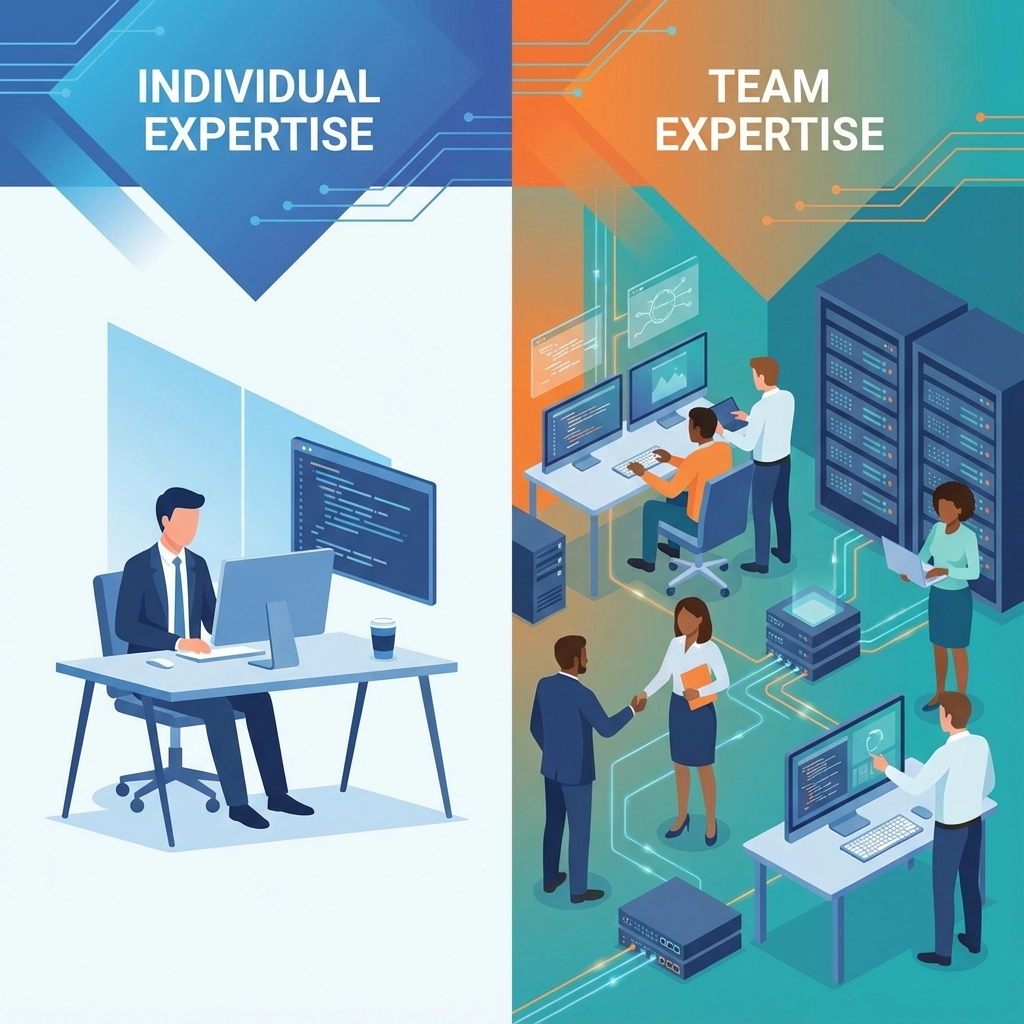
A team of specialists with diverse expertise
24/7 monitoring and support capabilities
Access to enterprise-grade tools and technologies
Proactive maintenance and security monitoring
Vendor relationships and purchasing power
The reality is that most growing businesses need more than one person can provide. Cybersecurity, cloud management, network administration, and help desk support require different skill sets that are expensive to maintain in-house.
Scalability and Growth Considerations
If your business is growing, scalability should be a major factor in your decision. Here's how each approach handles growth:
Scaling In-House IT
When you outgrow your single IT person, you face a challenging transition. Hiring a second IT professional nearly doubles your costs, but you might not have enough work to justify a full-time position. You'll also need to determine who manages whom and how to divide responsibilities effectively.
Scaling Outsourced IT
Managed service providers are built for scalability. As you add employees, locations, or complexity, your MSP can adjust resources accordingly. Need help with a special project? They can assign additional expertise temporarily. Opening a new office? They can replicate your IT infrastructure quickly.
This flexibility becomes crucial during periods of rapid growth or seasonal fluctuations in your business.
The Co-Managed IT Option
There's actually a third option that many Hampton Roads businesses find ideal: co-managed IT. This hybrid approach combines the best of both worlds.
With co-managed IT, you might have an internal IT person handling day-to-day user support and basic maintenance, while your managed service provider handles:
Advanced cybersecurity monitoring and response
Infrastructure planning and management
Backup and disaster recovery
Complex projects and implementations
After-hours and weekend support
This approach works particularly well for businesses with 25-50 employees who need some on-site presence but can't justify multiple full-time IT positions.

Cybersecurity and Proactive Planning
Modern cybersecurity requires specialized knowledge and constant vigilance. Cyber threats evolve daily, and staying ahead requires dedicated focus and expertise.
In-House Cybersecurity Challenges
Your internal IT person likely wears many hats. Between helping users with password resets, maintaining printers, and managing software updates, how much time can they realistically dedicate to monitoring security threats, analyzing logs, and implementing advanced protection measures?
Cybersecurity expertise commands premium salaries: often $90,000+ for qualified professionals. For most growing businesses, this investment doesn't make financial sense.
Managed IT Cybersecurity Advantages
Reputable managed service providers invest heavily in cybersecurity tools, training, and processes. They monitor threats across hundreds of clients, giving them insights into emerging attack patterns that single-client IT professionals simply can't match.
Your MSP should provide:
24/7 security monitoring and threat detection
Regular vulnerability assessments
Employee cybersecurity training
Incident response planning
Compliance assistance for industry regulations
This level of cybersecurity protection would cost tens of thousands of dollars to implement independently.
When In-House IT Makes Sense
Despite the advantages of outsourced IT, there are situations where hiring internal IT staff makes more sense:
You Have Highly Specialized Systems
If your business runs on custom software or specialized equipment that requires deep, ongoing expertise, an in-house expert might be necessary. Industries like manufacturing or specialized healthcare often fall into this category.
You Need Constant On-Site Presence
Some businesses require IT support to be physically present throughout operating hours. If your employees frequently need hands-on assistance or your systems require regular physical maintenance, in-house IT might be worth the investment.
You Have Significant IT Budget and Needs
Larger businesses (typically 100+ employees) often have enough IT needs to justify multiple full-time positions. At this scale, you can build a diverse internal team with specialized roles.
You Have Extremely Sensitive Data
While managed service providers can be very secure, some organizations with highly sensitive data prefer to keep all IT functions internal for compliance or security reasons.
When Outsourced IT Is Better
For most growing businesses in the Hampton Roads area, managed IT services offer significant advantages:
You Want Predictable Costs
Monthly managed IT fees are predictable and scalable. You won't face surprise expenses for training, certifications, or replacement hiring.
You Need Diverse Expertise
Modern businesses rely on cloud services, cybersecurity, mobile device management, and various software platforms. Managed service providers maintain expertise across all these areas.
You Want to Focus on Your Business
When IT is handled proactively by experts, you can focus your energy and resources on growing your core business rather than managing technology challenges.
You Need Better Cybersecurity
The cybersecurity landscape is complex and constantly evolving. Managed service providers invest significantly in security tools, training, and processes that most businesses can't justify independently.

Larger MSP or Smaller MSP: Which Fits You?
If you're weighing a boutique MSP versus a bigger provider, think of it like choosing between a small clinic and a regional hospital (both can be excellent; the right fit depends on your needs).
A larger MSP may make sense when:
You're growing beyond 75–100 users across multiple sites or states
You want broad, around-the-clock on-site dispatch across many locations
You require strict, audited compliance programs (SOC 2/ISO) and formalized, standardized processes
You need extensive project throughput at the same time (e.g., multiple migrations running in parallel)
You prefer rigid SLAs with defined shift coverage and dedicated escalation tiers
A smaller MSP may be a better fit when:
You have 10–50 users and value direct access to senior engineers
You want owner-led guidance, faster decision loops, and tailored roadmaps
Your priority is proactive care, cybersecurity, and steady, practical improvements
You appreciate local presence and predictable, right-sized costs
You occasionally have specialized projects
You just want someone keeping an eye on your environment, without all of the extra overhead
Either way, look for:
Transparent security stack and ongoing monitoring (with clear reports)
A documented 12–24 month roadmap aligned to your growth
Response and resolution targets by priority level
Backup, recovery, and exit plans you can verify
References from similar-sized organizations in your region
If you're unsure, we can help you evaluate both paths objectively—even if the best answer is a provider that's not us.
Making the Right Choice for Your Business
Consider these questions as you evaluate your options:
How complex is your current IT environment? Simple setups might work with in-house support, while complex environments benefit from managed services.
How often do you experience IT issues? Frequent problems might indicate the need for more proactive management.
What's your growth trajectory? Rapid growth often favors the scalability of managed services.
How important is cybersecurity to your business? Higher security needs generally favor managed IT providers.
Do you have the budget for multiple IT positions? Most businesses need more expertise than one person can provide.
How much do you want to focus on IT management? Managing internal IT staff requires time and expertise that might be better spent on your core business.
For most businesses with 10-50 employees in Virginia Beach, Chesapeake, Norfolk, and the broader Hampton Roads area, managed IT services offer the best combination of expertise, cost-effectiveness, and scalability.
How VaBeachTech Can Help
At VaBeachTech, we understand that every business has unique IT needs. We're a small, owner-led MSP serving Hampton Roads and backed by a network of specialized contractors we engage for complex projects and extra capacity. We offer flexible managed IT services designed for growing local businesses. Whether you need fully managed IT, co-managed support to complement your existing staff, or project-based consulting, we can tailor services to fit your budget and requirements.
Our proactive approach means we monitor your systems 24/7, preventing problems before they impact your business. We handle cybersecurity, backup management, help desk support, and strategic planning, so you can focus on what you do best.
We also understand that the transition from DIY IT or basic support to professional managed services can feel overwhelming. That's why we start every relationship with a comprehensive assessment of your current environment and a clear roadmap for improvements. And if your needs point toward a larger MSP, we'll say so and help you evaluate options.
Ready to explore how managed IT services could benefit your growing business? We'd be happy to discuss your specific situation and show you exactly how we can help you achieve more reliable, secure, and efficient technology operations.
Schedule a consultation today to learn more about how VaBeachTech can support your business growth with professional IT services tailored to Hampton Roads businesses.
Comments